
Agilent 1100 HPLC Service & Maintenance
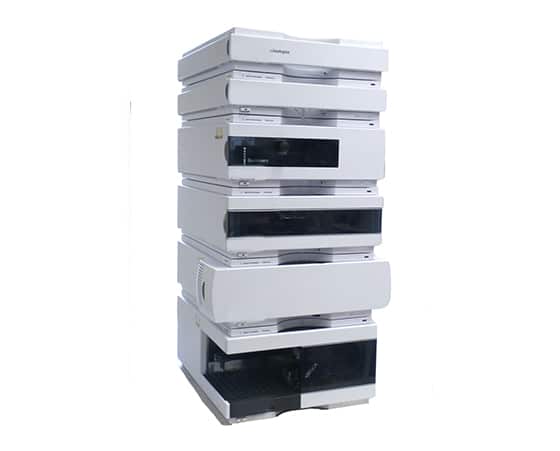
Service & Maintenance Support for the Classic Lab Workhorse
Reliable operation of your Agilent 1100 Series HPLC system is critical for consistent chromatographic performance, throughput and uptime. ILS provides independent service, preventative maintenance and break-fix repair for Agilent 1100 Series instruments. Our local engineers offer 48-hour response time, and we can service a wide range of instruments across your portfolio.
About the 1100 Series: Reliable Solvent Delivery & LC Performance
The Agilent 1100 Series (including capillary LC configurations) is a widely deployed modular HPLC platform, used in labs that need reliable liquid chromatography performance. The platform is commonly used in pharmaceutical, biotech, environmental and food testing laboratories. Typical use cases include routine separations, method development, QC testing, impurity profiling and contaminant analysis.
The 1100 Series is a modular platform. ILS engineers are trained across the full range of 1100 Series modules and common configurations, including standalone and stacked capillary LC setups. Most 1100 systems run under ChemStation or OpenLab CDS, and ILS engineers support both — including communication faults between modules, method configuration issues and ChemStation error diagnosis.
| Module | Description |
|---|---|
| G1310A / G1311A | Isocratic & Quaternary Pump — single-solvent and multi-solvent gradient delivery; quaternary capable of up to four solvents at high pressure |
| G1312A | Binary Pump — high-pressure binary gradient; used for two-solvent gradient work |
| G1313A / G1329A | Standard & Thermostatted Autosampler — automated sample injection with optional temperature control for thermally sensitive samples |
| G1315A / G1315B | Diode Array Detector (DAD) — simultaneous UV/Vis detection across the full wavelength range with spectral confirmation capability |
| G1314A | Variable Wavelength Detector (VWD) — single-wavelength UV detection optimized for high sensitivity at a fixed wavelength |
| G1321A | Fluorescence Detector (FLD) — excitation/emission detection for high-sensitivity analysis of fluorescent compounds |
| G1362A | Refractive Index Detector (RID) — universal concentration-based detection for non-UV-absorbing compounds such as sugars, polymers, and alcohols |
| G1385A | Evaporative Light Scattering Detector (ELSD) — universal mass-based detection for non-volatile, non-UV-absorbing compounds; compatible with gradient elution where RID is not |
| G1322A | Vacuum Degasser — continuous in-line solvent degassing to eliminate dissolved gases and reduce baseline noise and pressure fluctuation |
| G1316A | Thermostatted Column Compartment (TCC) — precise temperature control for improved retention time reproducibility and method consistency |
| G1323B | ChemStation Controller — system control, method management, and data acquisition via Agilent ChemStation software |
Preventative Maintenance for the Agilent 1100 Platform
Routine preventative maintenance is essential to keeping the Agilent 1100 Series stable and compliant, especially where unplanned downtime, leaks or pressure faults can disrupt reporting and regulatory timelines. Labs can perform this work in-house, tap Agilent support directly, or work with an independent service provider like ILS.
In general, Agilent 1100 maintenance should be focused on stabilizing solvent delivery, maintaining leak-tight fluidic paths and identifying aging components.
Basic Agilent 1100 Preventative Maintenance
Daily
- Visual inspections for leaks at pump heads, fittings, capillaries, and detector flow cells
- Verification of stable flow rates and system pressure
- Monitoring of baseline noise and signal stability
Monthly
- Inspection of solvent inlet filters and degasser performance
- Review of pump seal and check valve condition; monitoring for pulsation or pressure fluctuation indicative of early wear
- Inspection of needle seat and rotor seal condition for carryover or retention time drift
- Monitoring for contamination or baseline drift
Quarterly
- Performance verification and system suitability testing
- Inspection of vacuum degasser operation
- Evaluation of pressure trends for restrictions, column fouling, or degrading check valve performance
- Assessment of detector lamp hours and output stability
Annual
- Comprehensive fluidics inspection
- Pump seal and check valve replacement as required
- Needle seat and rotor seal replacement as required
- Detector flow cell cleaning and inspection
- Detector lamp inspection and replacement as required
- Calibration and performance validation
Common Issues Addressed During Maintenance
Fluid Delivery & Flow Path Integrity
- Pump seal wear and check valve sticking
- Solvent delivery inconsistency due to air ingress
- Flow path contamination affecting system performance
Vacuum & Degassing System
- Degasser vacuum pump failure and not-ready states
- Bubble formation in solvent lines
- Baseline instability from inadequate degassing
Autosampler & Injection System
- Needle seat wear causing carryover or injection volume errors
Detection & Optics
- DAD lamp aging and output degradation
- Detector fouling affecting signal quality
Column & Sample Path
- Column fouling reducing separation performance
- Decreased retention time repeatability
Calibration & Method Performance
- Failed or inconsistent system suitability results
- Method performance degradation over time
Electronics & Connectivity
- Power supply instability
- Leak sensor triggers and intermittent communication errors between modules
“ILS listens. They will help you troubleshoot over the phone if you want to try and get stuff out faster, but if not, they usually will show up the next day without making you jump through a million hoops.”
Common Agilent 1100 Fault Status Troubleshooting
Agilent 1100 LC system faults are typically reported via the system control interface or ChemStation workstation software. Module status indicators may display not-ready or error states to help isolate the affected component — whether that’s the quaternary or binary pump, autosampler, degasser or detector stack.
Agilent systems do not rely on a single universal fault code. Rather, troubleshooting must be performed by a trained maintenance professional, like an ILS engineer. Common symptoms of Agilent 1100 faults include high or unstable system pressure, pump pulsation or gradient delivery errors, leak detection alerts, degasser vacuum errors and detector signal instability.
ILS Offers Trustworthy, Affordable Third-Party Service for Agilent 1100 Systems
Having an issue with your Agilent 1100 HPLC system? ILS has the answer. Our team of engineers provides preventative maintenance, troubleshooting and emergency repairs nationwide. Our team is held to the same quality standards as OEM engineers, but we’re set apart by true 48-hour response times, multi-vendor service, and flexible engagement models.
If you simply need your Agilent 1100 HPLC to deliver reliable results with zero downtime, ILS is your best option.
No time for downtime.

6909 Columbus Rd. SW
Granville, OH 43023
sales@innlabserv.com
(614) 858-5305
© 2019 Innovative Lab Services. All rights reserved.